Alohaeigo
  • Welcome
  • Homework
  • Contents
  • Study Links
  • Student Page
  • Volunteering
  • Vocabulary

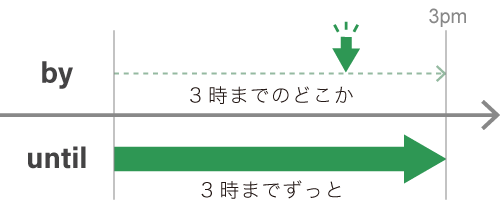
Until and By

5/23/2019

0 Comments

 
Picture
He held the post ______ 1897.
  • 同30年まで務める。
He kept sleeping ______ evening.
  • そのまま夕方まで寝た
He served there ______ he died.
  • 没年月日まで在任。
I cannot wait ______ next week.
  • 来週が待ち遠しい。
I drew pictures ______ the evening.
  • 夕方まで絵を描いた。
I had to arrive at the office ______ 10am this morning.
  • 今朝10時までに事務所に到着しなければならなかった。
I had to finish the work ______ yesterday.
  • 私は昨日までにその仕事を仕上げなければなりませんでした。
I have to return this DVD to the rental store ______ Wednesday.
  • このDVD、水曜日までにレンタル店に返さないといけないんだ。
I slept from 8AM ______ 1PM.
  • 8時から13時まで寝ました。
I want an answer ______ tomorrow morning.
  • 明日の朝までに返事がほしい
I want that ______ today.
  • 私はそれを今日までに欲しい。
I want to retire ______ the end of this month.
  • 今月末で退職したいです
I was on vacation ______ yesterday.
  • 昨日までお休みでした。
I will contact you ______ tomorrow morning.
  • 明日の朝迄にご連絡します。
I will not fail to have it ready ______ tomorrow evening.
  • 明晩までにはきっとお間に合わせます
I will pay ______ the end of today.
  • 今日中に支払います
I will sleep ______ 10pm.
  • 22時までに寝ます。
I work ______ 5PM.
  • 私の仕事は17時までです。
I'll stay here ______ ten.
  • 10時までここにいます。
I’ll be here ______ three o’clock.
  • 私は3時”までに“ここにいます。
I’ll be here ______ three o’clock.
  • 私は3時”まで”ここにいます。
I’m staying in London ______ October 5th.
  • 10月5日までロンドンに滞在してます。
It had been good ______ now.
  • 今までは良好だった。
It will be ready ______ six this evening.
  • 今日の夕方6時にはできます。
Let's wait ______ six o'clock.
  • 6時まで待ちましょう。
Memorize the poem ______ next week.
  • 来週までにその詩を暗記しなさい。
Mr. Smith should have left Tokyo ______ yesterday.
  • スミスさんは昨日までに東京を去ったはずです。
Mr. Smith was staying in Tokyo ______ yesterday.
  • スミスさんは昨日まで東京に滞在していました。
Please finish the report ______ Friday.
  • 金曜日までにそのレポートを終えてください。
Please reply ______ the end of the day today.
  • 今日中に返答をください。
Please send that ______ today.
  • それは今日までに送ってください。
Please stay there ______ Friday.
  • 金曜日までそこに滞在してください。
Soak seaweed in water ______ tender.
  • 海藻を水で戻す。
The meeting lasted ______ 5.
  • 会議は五時まで続いた。
The wind will die ______ evening.
  • 風は夕方までにやむだろう.
They will be finished ______ the end of the year.
  • 今年いっぱいででき上がる
This boom continued ______ around 2005.
  • 2005年頃まで続いた。
Wait ______ tomorrow morning.
  • 明日の朝まで待ちなさい。
Wait ______ two o'clock.
  • 2時まで待て.
We have school ______ four o'clock.
  • 学校は 4 時まである.
Well, good‐bye ______ we meet again.
  • ではまたそのうちに.
Will that be finished ______ today?
  • それは今日中に終わりますか?
Answers
He held the post until 1897.
  • 同30年まで務める。
He kept sleeping until evening.
  • そのまま夕方まで寝た
He served there until he died.
  • 没年月日まで在任。
I cannot wait until next week.
  • 来週が待ち遠しい。
I drew pictures until the evening.
  • 夕方まで絵を描いた。
I had to arrive at the office by 10am this morning.
  • 今朝10時までに事務所に到着しなければならなかった。
I had to finish the work by yesterday.
  • 私は昨日までにその仕事を仕上げなければなりませんでした。
I have to return this DVD to the rental store by Wednesday.
  • このDVD、水曜日までにレンタル店に返さないといけないんだ。
I slept from 8AM until 1PM.
  • 8時から13時まで寝ました。
I want an answer by tomorrow morning.
  • 明日の朝までに返事がほしい
I want that by today.
  • 私はそれを今日までに欲しい。
I want to retire by the end of this month.
  • 今月末で退職したいです
I was on vacation until yesterday.
  • 昨日までお休みでした。
I will contact you by tomorrow morning.
  • 明日の朝迄にご連絡します。
I will not fail to have it ready by tomorrow evening.
  • 明晩までにはきっとお間に合わせます
I will pay by the end of today.
今日中に支払います
I will sleep until 10pm.
  • 22時までに寝ます。
I work until 5PM.
  • 私の仕事は17時までです。
I'll stay here until ten.
  • 10時までここにいます。
I’ll be here by three o’clock.
  • 私は3時”までに“ここにいます。
I’ll be here until three o’clock.
  • 私は3時”まで”ここにいます。
I’m staying in London until October 5th.
  • 10月5日までロンドンに滞在してます。
It had been good until now.
  • 今までは良好だった。
It will be ready by six this evening.
  • 今日の夕方6時にはできます。
Let's wait until six o'clock.
  • 6時まで待ちましょう。
Memorize the poem by next week.
  • 来週までにその詩を暗記しなさい。
Mr. Smith should have left Tokyo by yesterday.
  • スミスさんは昨日までに東京を去ったはずです。
Mr. Smith was staying in Tokyo until yesterday.
  • スミスさんは昨日まで東京に滞在していました。
Please finish the report by Friday.
  • 金曜日までにそのレポートを終えてください。
Please reply by the end of the day today.
  • 今日中に返答をください。
Please send that by today.
  • それは今日までに送ってください。
Please stay there until Friday.
  • 金曜日までそこに滞在してください。
Soak seaweed in water until tender.
  • 海藻を水で戻す。
The meeting lasted until 5.
  • 会議は五時まで続いた。
The wind will die by evening.
  • 風は夕方までにやむだろう.
They will be finished by the end of the year.
  • 今年いっぱいででき上がる
This boom continued until around 2005.
  • 2005年頃まで続いた。
Wait until tomorrow morning.
  • 明日の朝まで待ちなさい。
Wait until two o'clock.
  • 2時まで待て.
We have school until four o'clock.
  • 学校は 4 時まである.
Well, good‐bye until we meet again.
  • ではまたそのうちに.
Will that be finished by today?
  • それは今日中に終わりますか?
0 Comments

High vs tall

5/23/2019

0 Comments

 
Picture
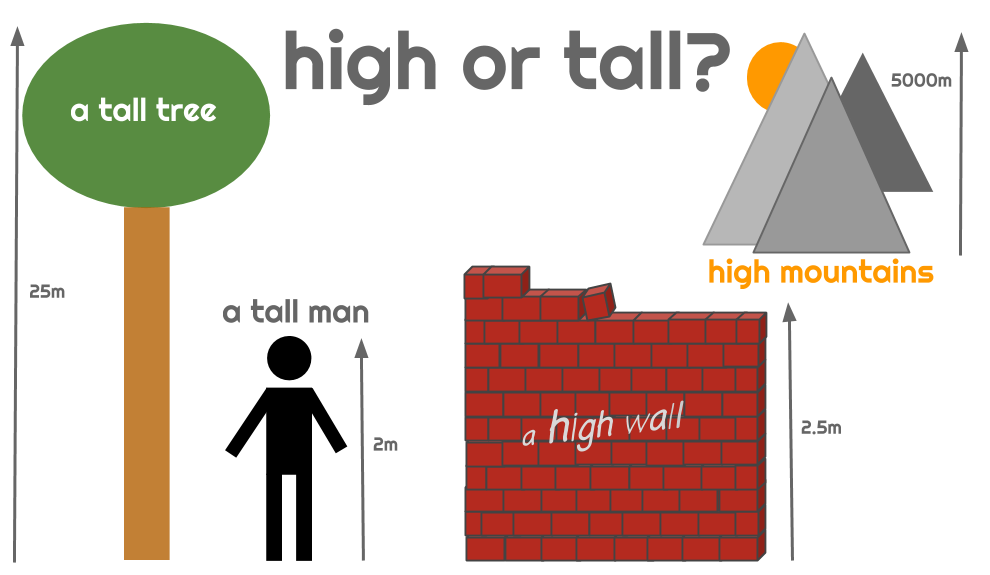
​したがってhighを使うときは、その起点への意識は薄くなります。
したがってtallを使うときは地面や床が起点として意識の中に含まれます。
主として空間的な高さのレベルを表します。
人や物が、その立っている地面や床から上に伸びている距離を表します。
通常は、細長く垂直に上に伸びている物体がイメージされます。
A monkey is climbing up a _______ tree.
  • 猿が高い木に登っていく。
Foreigners are _______.
  • 西洋人は背が高い
Fried foods are _______ in fat.
  • 揚げ物は脂肪の含有率が高い
How _______ you are.
  • 君はなんて背が高いんだ。
I got a _______ score on the test.
  • 私はそのテストで高いスコアを得た。
It is 301 meters _______.
  • 標高301m。
It is comical to see a short man in a _______ hat.
  • 背の低い人が高帽をかぶるとおかしい
Mary is really _______.
  • メアリーは本当に背が高い。
She is wearing _______ heels.
  • 彼女はハイヒールは履いています。
Some players are as _______ as two meters.
  • 2メートルくらい身長がある選手もいます。
Superman is able to leap _______ buildings.
  • スーパーマンは高い建物を飛び越えることができる
Symptoms of that are _______ fever, stuffy nose, and diarrhea.
  • それの症状は高熱、嘔吐、下痢などである。
That bridge is _______.
  • あの橋は高い。
That _______ tree is about 100 years old.
  • あの背の高い木は樹齢約100年です。
The birds are flying _______ in the sky.
  • 鳥が空高く飛んでいる。
The ceiling is very _______.
  • その天井はとても高い。
The horse is so _______ that I can not mount him.
  • この馬は高くて乗れない
The Merkel doll is 46 centimeters _______.
  • メルケル人形は高さが46センチある。
The museum is at the foot of that _______ tower.
  • その美術館なら、あの高いタワーの下にありますよ。
The price is _______.
  • 値が張る
The sun is _______.
  • 日脚が高い
The waves are _______.
  • 波が高い.
These falls are 30 ft. _______.
  • 滝は 30 フィートの高さだ.
They are 8.4m _______, gigantic wooden statues.
  • 高さ8.4メートルの巨大な木像
What a _______ mountain that is!
  • あれはなんて高い山なんだ!
What a _______ building that is!
  • あれはなんて高いビルなんだ!
Answers
A monkey is climbing up a tall tree.
  • 猿が高い木に登っていく。
Foreigners are tall.
  • 西洋人は背が高い
Fried foods are high in fat.
  • 揚げ物は脂肪の含有率が高い
How tall you are.
  • 君はなんて背が高いんだ。
I got a high score on the test.
  • 私はそのテストで高いスコアを得た。
It is 301 meters high.
  • 標高301m。
It is comical to see a short man in a tall hat.
  • 背の低い人が高帽をかぶるとおかしい
Mary is really tall.
  • メアリーは本当に背が高い。
She is wearing high heels.
  • 彼女はハイヒールは履いています。
Some players are as tall as two meters.
  • 2メートルくらい身長がある選手もいます。
Superman is able to leap tall buildings.
  • スーパーマンは高い建物を飛び越えることができる
Symptoms of that are high fever, stuffy nose, and diarrhea.
  • それの症状は高熱、嘔吐、下痢などである。
That bridge is high.
  • あの橋は高い。
That tall tree is about 100 years old.
  • あの背の高い木は樹齢約100年です。
The birds are flying high in the sky.
  • 鳥が空高く飛んでいる。
The ceiling is very high.
  • その天井はとても高い。
The horse is so tall that I can not mount him.
  • この馬は高くて乗れない
The Merkel doll is 46 centimeters tall.
  • メルケル人形は高さが46センチある。
The museum is at the foot of that tall tower.
  • その美術館なら、あの高いタワーの下にありますよ。
The price is high.
  • 値が張る
The sun is high.
  • 日脚が高い
The waves are high.
  • 波が高い.
These falls are 30 ft. high.
  • 滝は 30 フィートの高さだ.
They are 8.4m tall, gigantic wooden statues.
  • 高さ8.4メートルの巨大な木像
What a high mountain that is!
  • あれはなんて高い山なんだ!
What a tall building that is!
  • あれはなんて高いビルなんだ!
0 Comments

Transitive and Intransitive Verbs

5/23/2019

0 Comments

 
Picture
Bring me _____ the key.
  • キーを持ってきて。
Children depend _____ their parents.
  • 子供は親を頼りにする.
Did something happen _____ them?
  • 彼らはどうかしましたか?
Don't dwell _____ the past
  • 過去を振り返るな
Earthquakes often occur _____ Japan.
  • 日本では地震がよく起こる。
Hanako sent _____ the book by mail.
  • 花子は本を郵送した。
Have you read _____ my book?
  • 私の本読んだ?
He fell _____ the river.
  • 彼は川に落ちた。
He painted _____ the wall white.
  • 彼は壁を白く塗った.
He will arrive _____ Thailand at 8pm.
  • 彼は20時にタイに着きます。
I agree _____ you.
  • 同意します。
I passed _____ the exam.
  • 試験に合格した
I sleep _____ my window open.
  • 窓を明けたままで寝る
I sometimes wake _____ night.
  • ときどき夜に目が覚める。
I want _____ money.
  • お金がほしい
I want to vanish _____ nothingness.
  • 私は消えてなくなりたい。
I will buy you _____ dinner.
  • 夕食奢るよ。
I will go _____ a small trip.
  • 小旅行に行きます。
I will lend you _____ my fan.
  • 扇子を貸してあげます。
I will look _____ paintings.
  • 私は絵を鑑賞する。
I will respond _____ your question.
  • 質問に回答します。
I will send you _____ a letter.
  • 手紙を送る
I will swim _____ the ocean.
  • 海で泳ぐ。
I wrote _____ this book.
  • 僕がこの本を書いたんだ。
I'll wait _____ you.
  • 待ってあげる。
Japan is still struggling to emerge _____ recession.
  • 日本は今も景気後退から立ち直ろうと努力を続けている。
Let's clean _____ the classroom.
  • 教室を掃除しよう。
Let's inquire _____ our hotel reservations.
  • ホテルの確認をしよう。
Let's listen _____ some music.
  • 音楽を聞こう。
Man has evolved _____ the ape.
  • 人は猿から進化した
Many people die _____ cancer.
  • がんで死ぬ人が多い.
People laugh _____ me every time I dance.
  • 人々は私が踊るたびに笑う。
Please give me _____ a reply.
  • お返事ください
Please sit _____ that chair.
  • あなたはその椅子に座ってください。
Please take _____ a look.
  • 見てください
Shall we eat _____ something?
  • 何か食べようか?
She promised her _____ early return.
  • 彼女は早めに帰ると約束した
She refused _____ a hysterectomy.
  • 彼女は子宮摘出術を拒否した。
Superstrings exist _____ 10 dimensions.
  • 超ひもは10次元に存在する。
That amount of food will last them _____ a week.
  • あれだけの食料があれば、彼らは1週間持つだろう。
That looks as if it could collapse _____ any moment.
  • それは今にも崩れそうに見える。
That will disappear _____ a little bit.
  • それはもう少しでなくなります。
That won't appear _____ the market.
  • それは市場には出てない。
The boy kicked _____ the dog
  • 少年は犬を蹴った
The fever will rise _____ 40°.
  • この熱は四十度まで上がる
These boots belong _____ her.
  • この靴は彼女のものだ。
They can sing _____ songs.
  • 歌を歌うことができる。
They live _____ the country.
  • 田舎住まい
Answers
I agree with you.
  • 同意します。
That won't appear in the market.
  • それは市場には出てない。
He will arrive in Thailand at 8pm.
  • 彼は20時にタイに着きます。
These boots belong to her.
  • この靴は彼女のものだ。
That looks as if it could collapse at any moment.
  • それは今にも崩れそうに見える。
Children depend on their parents.
  • 子供は親を頼りにする.
Many people die of cancer.
  • がんで死ぬ人が多い.
That will disappear in a little bit.
  • それはもう少しでなくなります。
Don't dwell on the past
  • 過去を振り返るな
Japan is still struggling to emerge from recession.
  • 日本は今も景気後退から立ち直ろうと努力を続けている。
Man has evolved from the ape.
  • 人は猿から進化した
Superstrings exist in 10 dimensions.
  • 超ひもは10次元に存在する。
He fell into the river.
  • 彼は川に落ちた。
I will go on a small trip.
  • 小旅行に行きます。
Did something happen to them?
  • 彼らはどうかしましたか?
Let's inquire about our hotel reservations.
  • ホテルの確認をしよう。
Let's listen to some music.
  • 音楽を聞こう。
People laugh at me every time I dance.
  • 人々は私が踊るたびに笑う。
They live in the country.
  • 田舎住まい
I will look at paintings.
  • 私は絵を鑑賞する。
That amount of food will last them for a week.
  • あれだけの食料があれば、彼らは1週間持つだろう。
Earthquakes often occur in Japan.
  • 日本では地震がよく起こる。
I will respond to your question.
  • 質問に回答します。
The fever will rise to 40°.
  • この熱は四十度まで上がる
Please sit in that chair.
  • あなたはその椅子に座ってください。
I sleep with my window open.
  • 窓を明けたままで寝る
I will swim in the ocean.
  • 海で泳ぐ。
I want to vanish into nothingness.
  • 私は消えてなくなりたい。
I sometimes wake at night.
  • ときどき夜に目が覚める。
I'll wait for you.
  • 待ってあげる。
​Bring me the key.
  • キーを持ってきて。
Please take a look.
  • 見てください
She refused a hysterectomy.
  • 彼女は子宮摘出術を拒否した。
The boy kicked the dog
  • 少年は犬を蹴った
I will buy you dinner.
  • 夕食奢るよ。
They can sing songs.
  • 歌を歌うことができる。
I want money.
  • お金がほしい
She promised her early return.
  • 彼女は早めに帰ると約束した
I will send you a letter.
  • 手紙を送る
He painted the wall white.
  • 彼は壁を白く塗った.
I will lend you my fan.
  • 扇子を貸してあげます。
I wrote this book.
  • 僕がこの本を書いたんだ。
Please give me a reply.
  • お返事ください
Have you read my book?
  • 私の本読んだ?
Shall we eat something?
  • 何か食べようか?
Let's clean the classroom.
  • 教室を掃除しよう。
Hanako sent the book by mail.
  • 花子は本を郵送した。
I passed the exam.
  • 試験に合格した
0 Comments

watch/look/seeの使い分け

5/23/2019

0 Comments

 
Picture
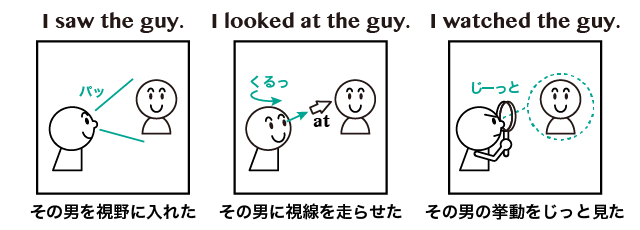
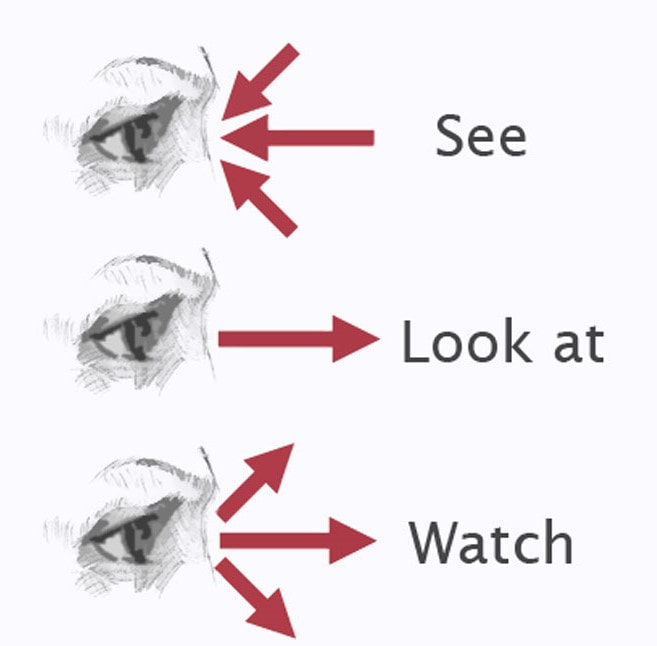
​watchの使い方ですが、シンプルで「動いているもの」を見る。
lookは何かを見ようとしてそちらを見つめる「動作」で、
seeはぼんやり座っていても見えている「状態」です。
________ you next week!
  • また来週!
After that, I will ________ fireworks.
  • その後花火を見ます
Did you ________ the opening ceremony?
  • 開会式を観ましたか?
Does he plan on ________ that show?
  • 彼はその番組を見る予定ですか?
Don't delay ________ the doctor.
  • すぐ医者に行きなさい
Have a _________ the world map.
  • 世界地図を見てごらん。
He ________ her and blushed.
  • 彼女を見てぽっとした。
He ________ the horse race through his binocular.
  • 彼は双眼鏡で競馬を見た。
He ________ two buildings on the right.
  • 彼は右手に2棟のビルを見た。
He is ________ birds.
  • 彼は鳥を見ています
He is ________ my actions.
  • 彼は私の行動を見張っている。
He is ________ the sunrise.
  • 彼は日の出を見ています。
He is ________ a job at the municipal office.
  • 彼は市役所に就職する。
He was ________ the sky.
  • 彼は空を見ていた。
I ________ television.
  • テレビを見る。
I ________ the Olympics opening ceremony.
  • オリンピックの開会式を見た。
I ________ a movie last night.
  • 私は昨晩映画を見た。
I ________ a spider spin a web.
  • 私はクモが巣を張るのを見た
I ________ a town in the distance.
  • 遠方に街が見えた。
I ________ a woman in black.
  • 黒い服の女をみた。
I ________ Bob this morning.
  • 私はけさボブにあった。
I ________ but ________ nothing.
  • 私は見た、でも何も見えなかった。
I ________ him at the office.
  • 会社で会った
I ________ him but once.
  • ほんの一度会っただけ。
I ________ our teacher in the bookstore.
  • 私たちの先生を本屋で見かけた。
I ________ some smoke in the distance.
  • 遠くに煙が見えた
I am ________ a present for my mother.
  • 母にプレゼントを探しています。
I am ________ my glasses.
  • メガネを探している。
I am _________ the sea.
  • 私は海を見ています。
I cried when I ________ that.
  • それを見て泣きました。
I emailed after ________ your advertisement.
  • あなたの広告を見てメールしました。
I get sleepy ________ numbers.
  • 私は数字を見ていると眠くなる。
I got sleepy ________ the cat.
  • ネコ見てたら眠くなってきた。
I have to learn from ________ you.
  • あなたを見習わなくてはならない
I like ________ various stores.
  • 色々なお店を見るのが好きです。
I never tire of ________ this view.
  • この景色はいつ見ても好い
I prefer ________ baseball.
  • 野球を見ることを好む。
I think I'm being ________ .
  • 私はどうも監視されているようだ.
I want to go whale ________ .
  • ホエールウォッチングに行きたい
I was just ________ judo.
  • ちょうど柔道を見ていました。
I was moved when I ________ it.
  • それを見て感動した。
I will ________ over that class.
  • その授業を見守る。
I will _________ paintings.
  • 私は絵を鑑賞する。
I will tell you exactly what I ________.
  • 見たままを話そう
I'll take a _________ the documents.
  • 書類を見ておきます。
I'm ________ the scissors.
  • はさみを探しています
I'm going to ________ a movie.
  • 映画を観るつもりです。
Just _________ that rainbow!
  • あの虹を見てごらんよ!
May I _________ the store goods?
  • お店の品物を見ても良いですか?
My mom was ________ my neck.
  • 母は私の首もとを見ていました。
No one ________ the bridge.
  • 誰も橋を見なかった。
Please ________ your step.
  • 足元にご注意下さい。
She has a face worth _________.
  • ちょっと拝めた顔だ
That was the last I ________ of him.
  • あれっきり会わない
The bird was ________ worms.
  • 鳥は虫を探していた。
There, indeed, he ________ a lean, dark figure.
  • 痩せた人影が見えた。
We ________ some goats in the wood.
  • 私たちはその森で山羊をみた。
We ________ something white.
  • 何やら白いものが見えた.
We are ________ the same apple.
  • 私たちは同じりんごを見ています。
We are going to _________ the moon.
  • 私たちは月を見る。
Picture

See you next week!
  • また来週!
After that, I will watch fireworks.
  • その後花火を見ます
Did you watch the opening ceremony?
  • 開会式を観ましたか?
Does he plan on watching that show?
  • 彼はその番組を見る予定ですか?
Don't delay seeing the doctor.
  • すぐ医者に行きなさい
Have a look at the world map.
  • 世界地図を見てごらん。
He saw her and blushed.
  • 彼女を見てぽっとした。
He watched the horse race through his binocular.
  • 彼は双眼鏡で競馬を見た。
He saw two buildings on the right.
  • 彼は右手に2棟のビルを見た。
He is watching birds.
  • 彼は鳥を見ています
He is watching my actions.
  • 彼は私の行動を見張っている。
He is watching the sunrise.
  • 彼は日の出を見ています。
He is looking for a job at the municipal office.
  • 彼は市役所に就職する。
He was looking at the sky.
  • 彼は空を見ていた。
I watch television.
  • テレビを見る。
I watched the Olympics opening ceremony.
  • オリンピックの開会式を見た。
I watched a movie last night.
  • 私は昨晩映画を見た。
I watched a spider spin a web.
  • 私はクモが巣を張るのを見た
I saw a town in the distance.
  • 遠方に街が見えた。
I saw a woman in black.
  • 黒い服の女をみた。
I saw Bob this morning.
  • 私はけさボブにあった。
I looked but saw nothing.
  • 私は見た、でも何も見えなかった。
I saw him at the office.
  • 会社で会った
I saw him but once.
  • ほんの一度会っただけ。
I saw our teacher in the bookstore.
  • 私たちの先生を本屋で見かけた。
I saw some smoke in the distance.
  • 遠くに煙が見えた
I am looking for a present for my mother.
  • 母にプレゼントを探しています。
I am looking for my glasses.
  • メガネを探している。
I am looking at the sea.
  • 私は海を見ています。
I cried when I saw that.
  • それを見て泣きました。
I emailed after seeing your advertisement.
  • あなたの広告を見てメールしました。
I get sleepy looking at numbers.
  • 私は数字を見ていると眠くなる。
I got sleepy watching the cat.
  • ネコ見てたら眠くなってきた。
I have to learn from watching you.
  • あなたを見習わなくてはならない
I like looking at various stores.
  • 色々なお店を見るのが好きです。
I never tire of looking at this view.
  • この景色はいつ見ても好い
I prefer watching baseball.
  • 野球を見ることを好む。
I think I'm being watched.
  • 私はどうも監視されているようだ.
I want to go whale watching.
  • ホエールウォッチングに行きたい
I was just watching judo.
  • ちょうど柔道を見ていました。
I was moved when I saw it.
  • それを見て感動した。
I will watch over that class.
  • その授業を見守る。
I will look at paintings.
  • 私は絵を鑑賞する。
I will tell you exactly what I saw.
  • 見たままを話そう
I'll take a look at the documents.
  • 書類を見ておきます。
I'm looking for the scissors.
  • はさみを探しています
I'm going to watch a movie.
  • 映画を観るつもりです。
Just look at that rainbow!
  • あの虹を見てごらんよ!
May I look at the store goods?
  • お店の品物を見ても良いですか?
My mom was looking at my neck.
  • 母は私の首もとを見ていました。
No one saw the bridge.
  • 誰も橋を見なかった。
Please watch your step.
  • 足元にご注意下さい。
She has a face worth looking at.
  • ちょっと拝めた顔だ
That was the last I saw of him.
  • あれっきり会わない
The bird was looking for worms.
  • 鳥は虫を探していた。
There, indeed, he saw a lean, dark figure.
  • 痩せた人影が見えた。
We saw some goats in the wood.
  • 私たちはその森で山羊をみた。
We saw something white.
  • 何やら白いものが見えた.
We are looking at the same apple.
  • 私たちは同じりんごを見ています。
We are going to look at the moon.
  • 私たちは月を見る。​
0 Comments

whileとduringの使い分け

5/23/2019

0 Comments

 
Picture
duringは後ろに名詞などの句が続きます。during the day(日中)、during my summer vacation(夏休み中)という具合です。一方、whileは文や節(つまり主語+動詞があるもの)を続けて、while I was sleeping(私が眠 っていた間に)、while my mother was out(母が外出していた間に)のように表します。
Don’t talk (________) the test.
  • テスト中に喋るんじゃない。
He often ate meat (________) he was in Australia.
  • 彼はオーストラリア滞在中に、しばしば肉を食べていました。
He was sleeping (________) the movie is showing. 
  • 彼は上映中寝ていた。
Her family went on a trip to Okinawa (________) their summer vacation.
  • 彼女の家族は、夏休み中に沖縄に旅行に行った
I burned my finger (________) I was cooking.
  • 私は料理をしているときに指をやけどした.
I fell asleep (________) the movie.
  • 映画の最中に寝てしまった
I got injured (________) the match.
  • その試合中に怪我をした。
I got injured (________) I was playing football.
  • サッカーをしている間に怪我をした。
I got injured (________) playing football.
  • サッカーをしている間に怪我をした。
I noticed something important (________) the journey.
  • 旅の途中で重要なことに気が付いた。
I studied English (________) my stay in Australia. 
  • わたしはオーストラリアに滞在している間、英語を勉強しました。
I studied English (________) I was staying in Australia. 
  • わたしはオーストラリアに滞在している間、英語を勉強しました。
I studied English (________) I was staying in Canada. 
  • 私はカナダに滞在している間、英語を勉強しました。
I taught English to my sister (________) the summer vacation.
  • 夏休みの間ずっと妹の勉強を見ていた。
I visited the museum (________) my stay in Paris.
  • 私はパリ滞在中に 、その美術館を訪れた。
I visited the museum (________) I was staying in Paris.
  • 私はパリ滞在中にその美術館を訪れた。
I watched the movie (________) I was having coffee. 
  • わたしはコーヒーを飲みながら、その映画を見ていました。
I went to Canada (________) the summer vacation. 
  • 私は夏休みの間、カナダに行きました。
I went to Osaka (________) summer vacation.
  • 夏休みの間に大阪に行きました。
I went to Osaka (________) I was on summer vacation.
  • 夏休みの間に大阪に行きました。
Is it possible to maintain a good posture (________) sitting during working hours?
  • 勤務時間中、座って勤務しながら姿勢を矯正することは可能ですか?
It started raining (________) the night.
  • 夜の間に雨が降り始めた
My father got back home (________) I was cooking. 
  • わたしが料理をしているとき、父が帰宅した。
My husband got back home (________) I was cooking. 
  • 私が料理をしているときに夫が帰宅した
My mother made dinner (________) I watched the movie.
  • わたしが映画を観ている間、母は夜ご飯を作っていた。
My mother met her old friends (________) her stay in Tokyo.
  • うちのお母さんは、東京に滞在してる間に昔からの友達に会ったんだ。
My mother met her old friends (________) she was staying in Tokyo.
  • うちのお母さんは、東京にいる間に昔からの友達に会ったんだ。
My mother met her old friends (________) staying in Tokyo.
  • うちのお母さんは、東京にいる間に昔からの友達に会ったんだ。
My parents take care of our children (________) we were at work.
  • 私たちが仕事してる間、私の両親が子供たちの面倒を見てくれている。
Someone stole my bike (________) I was shopping at the supermarket.
  • スーパーで買い物をしている間に自転車を盗まれた。
We didn’t speak (________) the meal.
  •  食事中はしゃべらなかった。 
We didn’t speak (________) he was playing the piano.
  • 彼がピアノを弾いている間、私達はしゃべらなかった。
We didn’t speak (________) we were eating.
  • 食事中はしゃべらなかった。
We enjoyed fishing, swimming and shopping (________) we were on the island.
  • 私たちはその島にいる間、魚釣りや、水泳、ショッピングなどをして楽しみました。
We lived in our country villa (________) summer .
  • 私たちは夏の間、田舎の別荘で過ごした。
We visited our friend (________) summer holiday.
  • サマーホリデーの間に、私達は友達を訪ねました
We went shopping a lot (________) our trip to Paris.
  • パリへの旅行中に、私たちはたくさん買い物をしたんだよ
We were on an equatorial island (________) the winter vacation.
  • 冬期休暇の間、私たちは赤道付近の島にいました。
What do you want to do (________) your summer vacation?
  • 夏休みに何をしたいですか?
What is the best things to do (________) visiting Japan during the winter?
  • 冬場に日本を訪れた際は、どんな楽しみ方がありますか?
You must keep quiet (________) the presentation.
  • プレゼンテーションが行われている間は静かにしなさい
You shouldn't speak (________) you are eating.
  • 食事中は私語を慎むべきです
Picture
Don’t talk during the test.
  • テスト中に喋るんじゃない。
He often ate meat while he was in Australia.
  • 彼はオーストラリア滞在中に、しばしば肉を食べていました。
He was sleeping while the movie was showing. 
  • 彼は上映中寝ていた。
Her family went on a trip to Okinawa during their summer vacation.
  • 彼女の家族は、夏休み中に沖縄に旅行に行った
I burned my finger while I was cooking.
  • 私は料理をしているときに指をやけどした.
I fell asleep during the movie.
  • 映画の最中に寝てしまった
I got injured during the match.
  • その試合中に怪我をした。
I got injured while I was playing football.
  • サッカーをしている間に怪我をした。
I got injured while playing football.
  • サッカーをしている間に怪我をした。
I noticed something important during the journey.
  • 旅の途中で重要なことに気が付いた。
I studied English during my stay in Australia. 
  • わたしはオーストラリアに滞在している間、英語を勉強しました。
I studied English while I was staying in Australia. 
  • わたしはオーストラリアに滞在している間、英語を勉強しました。
I studied English while I was staying in Canada. 
  • 私はカナダに滞在している間、英語を勉強しました。
I taught English to my sister during the summer vacation.
  • 夏休みの間ずっと妹の勉強を見ていた。
I visited the museum during my stay in Paris.
  • 私はパリ滞在中に 、その美術館を訪れた。
I visited the museum while I was staying in Paris.
  • 私はパリ滞在中にその美術館を訪れた。
I watched the movie while I was having coffee. 
  • わたしはコーヒーを飲みながら、その映画を見ていました。
​I went to Canada during the summer vacation. 
  • 私は夏休みの間、カナダに行きました。
I went to Osaka during summer vacation.
  • 夏休みの間に大阪に行きました。
I went to Osaka while I was on summer vacation.
  • 夏休みの間に大阪に行きました。
Is it possible to maintain a good posture while sitting during working hours?
  • 勤務時間中、座って勤務しながら姿勢を矯正することは可能ですか?
It started raining during the night.
  • 夜の間に雨が降り始めた
My father got back home while I was cooking. 
  • わたしが料理をしているとき、父が帰宅した。
My husband got back home while I was cooking. 
  • 私が料理をしているときに夫が帰宅した
My mother made dinner while I watched the movie.
  • わたしが映画を観ている間、母は夜ご飯を作っていた。
My mother met her old friends during her stay in Tokyo.
  • うちのお母さんは、東京に滞在してる間に昔からの友達に会ったんだ。
My mother met her old friends while she was staying in Tokyo.
  • うちのお母さんは、東京にいる間に昔からの友達に会ったんだ。
My mother met her old friends while staying in Tokyo.
  • うちのお母さんは、東京にいる間に昔からの友達に会ったんだ。
My parents take care of our children while we were at work.
  • 私たちが仕事してる間、私の両親が子供たちの面倒を見てくれている。
Someone stole my bike while I was shopping at the supermarket.
  • スーパーで買い物をしている間に自転車を盗まれた。
We didn’t speak during the meal.
  • 食事中はしゃべらなかった。
We didn’t speak while he was playing the piano.
  • 彼がピアノを弾いている間、私達はしゃべらなかった。
We didn’t speak while we were eating.
  • 食事中はしゃべらなかった。
We enjoyed fishing, swimming and shopping while we were on the island.
  • 私たちはその島にいる間、魚釣りや、水泳、ショッピングなどをして楽しみました。
We lived in our country villa during summer .
  • 私たちは夏の間、田舎の別荘で過ごした。
We visited our friend during summer holiday.
  • サマーホリデーの間に、私達は友達を訪ねました
We went shopping a lot during our trip to Paris.
  • パリへの旅行中に、私たちはたくさん買い物をしたんだよ
We were on an equatorial island during the winter vacation.
  • 冬期休暇の間、私たちは赤道付近の島にいました。
What do you want to do during your summer vacation?
  • 夏休みに何をしたいですか?
What is the best things to do while visiting Japan during the winter?
  • 冬場に日本を訪れた際は、どんな楽しみ方がありますか?
You must keep quiet during the presentation.
  • プレゼンテーションが行われている間は静かにしなさい
​You shouldn't speak while you are eating.
  • 食事中は私語を慎むべきです
0 Comments

Go to/on/for/-ingの使い分け

5/23/2019

0 Comments

 
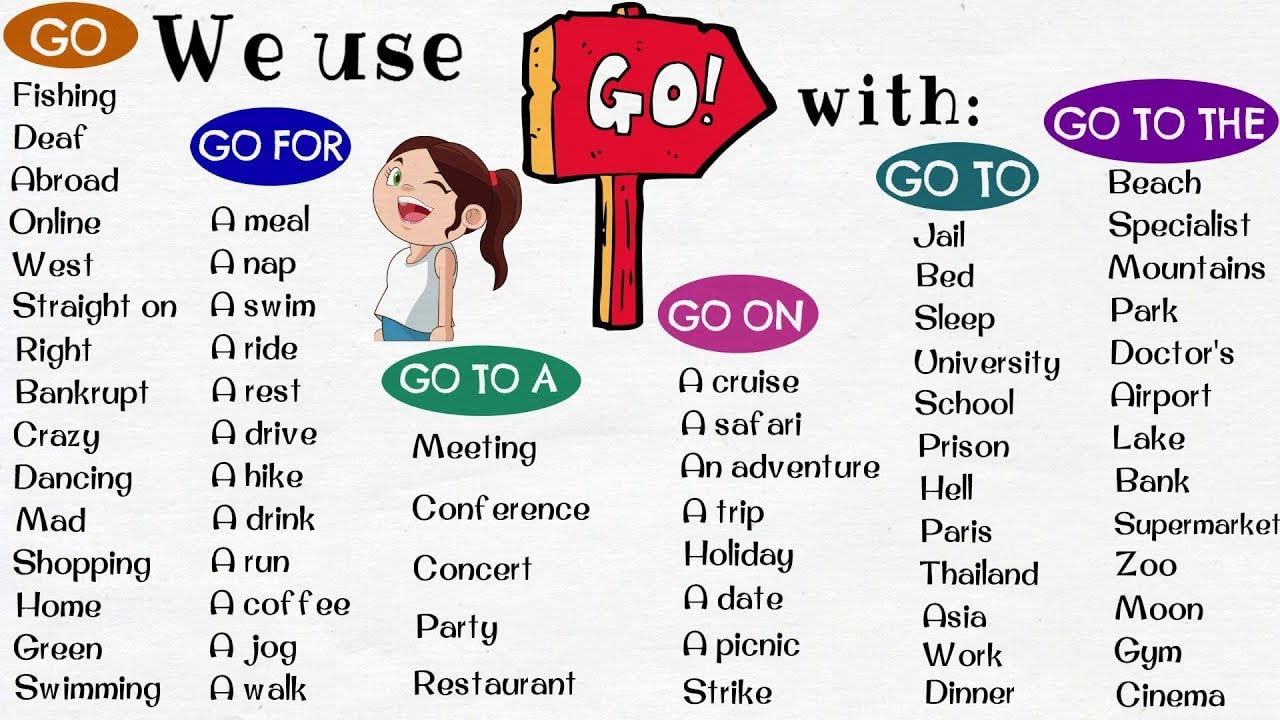
​​Go + Preposition + article
Go home, downtown, shopping, swimming, (gerunds, activities)
Go to class, work, university, bed, jail, Canada, Starbucks (set places)
Go to a party, conference, convenience store (unknown place)
Go to the bank, supermarket, dentist, doctor, airport (known place)
Go on a vacation, cruise, trip, break, date, tour (fun event)
Go for a walk, swim, drive, jog, hike, nap (verb used as a noun)
Picture
Are you hungry? Let’s go (____) lunch!
  • お腹すいた?ランチを食べに行きましょう!
Did you go (____) fishing? Did you catch a lot of fish?
  • 釣りに行ったの? 魚はたくさん釣れた?
Do you want to go (____) swimming?
  • あなたは泳ぎに行きたいですか?
Do you want to go out (____) a date on Friday?
  • 金曜日にデートしませんか?
Do you want to go (____) the park tomorrow?
  • 明日公園に行きませんか
Do you want to go (____) the salon with me?
  • あなたは私と一緒に美容室に行きたいですか?
Go (____) broke!
  • 当たって砕けろ。
Go (____) quality, not quantity.
  • 量より質を追求してください。
He went (____) a trip.
  • 彼は旅行に行った。
He went (____) Okinawa.
  • 沖縄へ行ったわ。
Henry went (____) vacation for a week.
  • ヘンリーは一週間の休暇旅行に出かけた。
His favorite band is going (____) a tour.
  • 彼の大好きなバンドがツアーに出発する。
How about going (____) a disco this weekend?
  • 週末にディスコに行くのはどうですか。
How about going (____) a sushi bar right now?
  • 今すぐ、すし屋さんに行くなんてどうですか。
How often do you go (____) a trip abroad?
  • どれくらい頻繁に海外旅行に行きますか。
I am going (____) a diet today.
  • 今日からダイッェットを始める。
I go (____) school.
  • 私は学校へ通っている。
I like going (____) a walk in the evening.
  • 夜になったら、散歩するのが好きです。
I must go (____) home, or my wife will kill me.
  • 家へ帰らなきゃ嫁さんに殺されるんだ。
I often go (____) downtown on Sunday.
  • 私は日曜日にはよく繁華街に出かける。
I plan to wake up early tomorrow to go (____) a run.
  • 走る為に明日の朝早く起きるつもりです。
I sometimes go (____) fishing with my friend.
  • 私は時々友達と魚釣りに行きます。
I used to go (____) swimming very often when I was a child.
  • 私は子供の頃よく泳ぎに行った。
I want to go (____) home right now.
  • もう帰りたい
I went (____) sightseeing in Saga.
  • 私は佐賀に観光に行きました。
I went (____) a movie with my friend.
  • 友達と映画に行ったわ。
I went (____) shopping with my mother.
  • 私は母と買い物に行きました。
I went (____) skiing for the first time last winter. It was fun!
  • 去年の冬初めてスキーへ行った。楽しかった。
I went (____) a drink with my mate.
  • 友達と飲みに行った。
I went (____) a massage today.
  • 私は今日マッサージに行きました。
I went (____) a prenatal check up this morning.
  • 私は今朝、妊婦検診に行った。
I went (____) a walk.
  • 私は散歩に行きました。
I went (____) training.
  • 私は実習に行きました。
I wish I could go (____) an adventure.
  • 冒険の旅に出られたらいいのに。
I’m going (____) a drink after work, so don’t wait up for me.
  • 仕事の後飲みに行くから、(待たないで)先に寝てて。
I’m going (____) a walk. Do you want to join me?
  • 散歩に行くけど、あなたも一緒に行かない?
I’m going to go (____) a trip abroad some day.
  • 私はいつか海外旅行へ行くつもりです。
I’m so excited! I can’t go (____) sleep!!
  • わくわくするわ!眠れな~い!!
If you have time let's go (____) a walk together.
  • もしあなたが暇なら一緒に散歩へ行こう。
In my opinion, children should go (____) bed early.
  • 私の意見を言わせてもらうと、子どもは早く寝るべきだと思います。
Let us go (____) foot!
  • 歩いて行こう
Let's go (____) a date.
  • デートしようよ
Let’s go (____) shopping at Macy’s!
  • メイシーズへショッピングに行きましょうよ。
Let’s go (____) dinner tonight.
  • 今夜夕食を食べに行こう。
My neighbor has gone (____) vacation.
  • 隣の人が休暇旅行に出かけた。
The President will go (____) TV to talk about the crisis.
  • 危機的局面について話すために大統領がテレビに出る。
The spring collection will go (____) sale next month.
  • 春コレクションのセールが来月始まります
Try not to go (____) sleep in class.
  • 授業中に眠らないようにしなさい。
Where did your son go (____) a school trip?
  • あなたの息子さんは修学旅行でどこへ行ったの?
Why don’t we go (____) swimming?
  • 泳ぎに行かない?
Why don’t you go (____) the job at the post office?
  • あなたは郵便局の仕事をしたらどうですか。
Would you go (____) a date with me?
  • デートしてくれますか。
Would you like to go (____) abroad?
  • 君は外国へ行きたいですか。
Would you like to go (____) fishing on Saturday afternoon?
  • 土曜日の午後、釣りに行きませんか。
Would you like to go (____) moon viewing with me?
  • あなたはお月見に私と一緒に行きませんか?
Would you like to go (____) a drink?
  • 飲みに行きませんか。
Would you like to go (____) a movie?
  • 映画を観に行きませんか。
You really need to stop going (____) shopping sprees every weekend!
  • 毎週末、ショッピングで散財するのは本当にやめなきゃだめだよ!
You let him go (____) jail for a month over in New Jersey.
  • あんたのせいであいつはニュージャージーで1ヶ月もぶちこまれるはめになったんだぜ。
I don't want to go (____) work.
  • 仕事に行きたくない
ANSWERS
Are you hungry? Let’s go to lunch!
  • お腹すいた?ランチを食べに行きましょう!
Did you go (x) fishing? Did you catch a lot of fish?
  • 釣りに行ったの? 魚はたくさん釣れた?
Do you want to go (x) swimming?
  • あなたは泳ぎに行きたいですか?
Do you want to go out on a date on Friday?
  • 金曜日にデートしませんか?
Do you want to go to the park tomorrow?
  • 明日公園に行きませんか
Do you want to go to the salon with me?
  • あなたは私と一緒に美容室に行きたいですか?
Go for broke!
  • 当たって砕けろ。
Go for quality, not quantity.
  • 量より質を追求してください。
He went on a trip.
  • 彼は旅行に行った。
He went to Okinawa.
  • 沖縄へ行ったわ。
Henry went on vacation for a week.
  • ヘンリーは一週間の休暇旅行に出かけた。
His favorite band is going on a tour.
  • 彼の大好きなバンドがツアーに出発する。
How about going to a disco this weekend?
  • 週末にディスコに行くのはどうですか。
How about going to a sushi bar right now?
  • 今すぐ、すし屋さんに行くなんてどうですか。
How often do you go on a trip abroad?
  • どれくらい頻繁に海外旅行に行きますか。
I am going on a diet today.
  • 今日からダイッェットを始める。
I go to school.
  • 私は学校へ通っている。
I like going for a walk in the evening.
  • 夜になったら、散歩するのが好きです。
I must go (x) home, or my wife will kill me.
  • 家へ帰らなきゃ嫁さんに殺されるんだ。
I often go (x) downtown on Sunday.
  • 私は日曜日にはよく繁華街に出かける。
I plan to wake up early tomorrow to go for a run.
  • 走る為に明日の朝早く起きるつもりです。
I sometimes go (x) fishing with my friend.
  • 私は時々友達と魚釣りに行きます。
I used to go (x) swimming very often when I was a child.
  • 私は子供の頃よく泳ぎに行った。
I want to go (x) home right now.
  • もう帰りたい
I went (x) sightseeing in Saga.
  • 私は佐賀に観光に行きました。
I went to a movie with my friend.
  • 友達と映画に行ったわ。
I went (x) shopping with my mother.
  • 私は母と買い物に行きました。
I went (x) skiing for the first time last winter. It was fun!
  • 去年の冬初めてスキーへ行った。楽しかった。
I went for a drink with my mate.
  • 友達と飲みに行った。
I went for a massage today.
  • 私は今日マッサージに行きました。
I went for a prenatal check up this morning.
  • 私は今朝、妊婦検診に行った。
I went for a walk.
  • 私は散歩に行きました。
I went for training.
  • 私は実習に行きました。
I wish I could go on an adventure.
  • 冒険の旅に出られたらいいのに。
I’m going for a drink after work, so don’t wait up for me.
  • 仕事の後飲みに行くから、(待たないで)先に寝てて。
I’m going for a walk. Do you want to join me?
  • 散歩に行くけど、あなたも一緒に行かない?
I’m going to go on a trip abroad some day.
  • 私はいつか海外旅行へ行くつもりです。
I’m so excited! I can’t go to sleep!!
  • わくわくするわ!眠れな~い!!
If you have time let's go for a walk together.
  • もしあなたが暇なら一緒に散歩へ行こう。
In my opinion, children should go to bed early.
  • 私の意見を言わせてもらうと、子どもは早く寝るべきだと思います。
Let us go on foot!
  • 歩いて行こう
Let's go on a date.
  • デートしようよ
Let’s go (x) shopping at Macy’s!
  • メイシーズへショッピングに行きましょうよ。
Let’s go for dinner tonight.
  • 今夜夕食を食べに行こう。
My neighbor has gone on vacation.
  • 隣の人が休暇旅行に出かけた。
The President will go on TV to talk about the crisis.
  • 危機的局面について話すために大統領がテレビに出る。
The spring collection will go on sale next month.
  • 春コレクションのセールが来月始まります
Try not to go to sleep in class.
  • 授業中に眠らないようにしなさい。
Where did your son go on a school trip?
  • あなたの息子さんは修学旅行でどこへ行ったの?
Why don’t we go (x) swimming?
  • 泳ぎに行かない?
Why don’t you go for the job at the post office?
  • あなたは郵便局の仕事をしたらどうですか。
Would you go on a date with me?
  • デートしてくれますか。
Would you like to go (x) abroad?
  • 君は外国へ行きたいですか。
Would you like to go (x) fishing on Saturday afternoon?
  • 土曜日の午後、釣りに行きませんか。
Would you like to go (x) moon viewing with me?
  • あなたはお月見に私と一緒に行きませんか?
Would you like to go for a drink?
  • 飲みに行きませんか。
Would you like to go to a movie?
  • 映画を観に行きませんか。
You really need to stop going on shopping sprees every weekend!
  • 毎週末、ショッピングで散財するのは本当にやめなきゃだめだよ!
You let him go to jail for a month over in New Jersey.
  • あんたのせいであいつはニュージャージーで1ヶ月もぶちこまれるはめになったんだぜ。
I don't want to go to work.
  • 仕事に行きたくない
0 Comments

forとfromとsinceの使い分け

5/23/2019

0 Comments

 
Picture
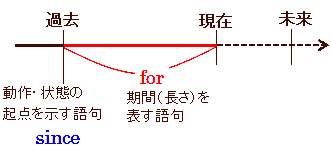
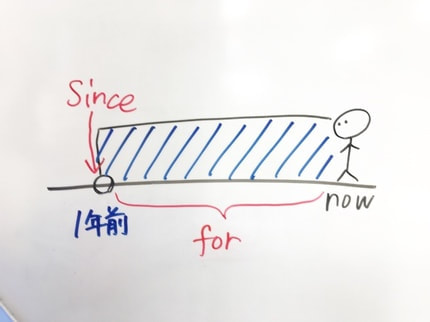
​from:「~から」(起点)since:「~以来ずっと」(継続)for:「期間」を表す、「~の間」
例) 『I have lived in Hinoemata village for one year.』:「私は桧枝岐村に一年間住んでいます」
例) 『I have lived in Hinoemata village since last year.』:「私は桧枝岐村に去年から住んでいます」
Barack Obama was president ________ 2008 to 2017.
  • バラク・オバマ氏は2008年から2017年まで大統領を務めた。
He has been absent from school ________ the day before yesterday.
  • 彼は一昨日からずっと学校を休んでいます。
He will start a new job ________ next Monday.
  • 彼は来週の月曜から、新しい仕事を始めるよ。
How long does it take ________ Tokyo by Shinkansen?
  • 新幹線で、東京からどのくらいかかるの?
I had been talking to her ________ 3 o’clock.
  • 3時から彼女と話していた。
I have been learning English ________ a long time.
  • 長い間、英語を勉強をしている。
I have been learning English ________ I went to America.
  • アメリカに行ってから、英語を勉強している。
I have been sick ________ a few days.
  • 私は2,3日前から病気です。
I have been swimming ________ 10 hours.
  • 私は10時間泳いでいた。
I have been talking to her ________ 3 o’clock.
  • 3時から彼女と話している。
I have known the singer ________ I was a child.
  • 私は子供の頃からずっとその歌手を知っています。
I have lived here in Sapporo ________ 2007.
  • 私は、2007年からここ札幌に住んでいます
I learnt English ________ a long time.
  • 何年間も英語を勉強していた。「今は英語を勉強していない」
I run ________ an hour every day.
  • 私は、毎日2時間走る。
I took a long vacation for the first time ________ I started my career as a journalist.
  • 記者の仕事を始めて以来、初めて長い休暇を取った。
I will be here ________ two hours.
  • 2時間ここにいるよ。
I’m sorry. I’ll be more careful ________ now on.
  • 申し訳ありませんでした。今後はもっと注意します。
It has been three years ________ the war.
  • 戦争が終わってから、三年もたった。
It has rained ________ last night.
  • 昨夜からずっと雨が降っています。
It hasn't rained ________ several weeks.
  • 数週間、雨が降っていません。
It is five years ________ we got married.
  • 私たちが結婚してから5年経ちます。
Last year, I went on a trip to Kyoto, which I hadn’t visited ________ my school trip.
  • 昨年、修学旅行以来訪れていなかった京都へ旅行に行った。(過去完了形)
Mother has been sick ________ yesterday.
  • 母はきのうからずっと病気です。
My friend has stayed with my family ________ a week.
  • 私の友人は1週間前からずっと私達の所に滞在しています。
My mother has been waiting ________ 6 o’clock.
  • 母は6時からずっと待ていたよ。
My son has been in Hokkaido ________ many years.
  • 私の息子は何年も前からずっと北海道に居ます。
My uncle has stayed in China ________ last week.
  • オジは先週からずっと中国に滞在しています。
Next month, it will have been three years ________ the tragic accident.
  • 来月でその悲劇的な事故から3年になる。(未来完了形)
Our new plant will start operation ________ next month.
  • 当社の新しい工場は来月から操業を開始します。
Out teacher has been busy ________ two days.
  • 私達の先生は2日前からずっと忙しい。
She has been married ________ 3 years.
  • 彼女は結婚して3年になります。
She has been married ________ 2007.
  • 彼女は2007年に結婚だ。
She studied at the library ________ the morning to the evening.
  • 彼女は朝から晩まで図書館で勉強してたんだよ。
She was married ________ 3 years.
  • 彼女は3年間していた。「もう離婚した」
Students in Japan go to school ________ Monday to Friday.
  • 日本の学生は月曜から金曜日まで学校に行きます。
The man has lived in Nagoya ________ he came to Japan.
  • その男性は日本に来てからずっと、名古屋に住んでいます。
The population growth rate has been declining ________ 1980’s.
  • 人口増加率は80年代から減少を続けている。(現在完了進行形)
The shop has been open ________ 2001.
  • そのお店は2001年から営業しています。
The shop is open ________ 9 a.m. on weekends.
  • 毎週末、そのお店は9時から開いています。
The store opens ________ 10am to 7pm.
  • その店の営業時間は午前10時から午後7時です。
We have been good friends ________ then.
  • 私達はそれ以来ずっと、仲良くやっています。
We have known each other ________ a long time.
  • 私たちは、知り合って長い。
We have known each other ________ childhood.
  • 私たちは子供の頃からの知り合いです。(現在完了形)
When the song became a million-seller, it was only one week ________ its release.
  • その曲がミリオンセラーになったのは、発売後わずか1週間後のことだった。
Picture
Barack Obama was president from 2008 to 2017.
  • バラク・オバマ氏は2008年から2017年まで大統領を務めた。
He has been absent from school since the day before yesterday.
  • 彼は一昨日からずっと学校を休んでいます。
He will start a new job from next Monday.
  • 彼は来週の月曜から、新しい仕事を始めるよ。
How long does it take from Tokyo by Shinkansen?
  • 新幹線で、東京からどのくらいかかるの?
I had been talking to her since 3 o’clock.
  • 3時から彼女と話していた。
I have been learning English for a long time.
  • 長い間、英語を勉強をしている。
I have been learning English since I went to America.
  • アメリカに行ってから、英語を勉強している。
I have been sick for a few days.
  • 私は2,3日前から病気です。
I have been swimming for 10 hours.
  • 私は10時間泳いでいた。
I have been talking to her since 3 o’clock.
  • 3時から彼女と話している。
I have known the singer since I was a child.
  • 私は子供の頃からずっとその歌手を知っています。
I have lived here in Sapporo since 2007.
  • 私は、2007年からここ札幌に住んでいます
I learnt English for a long time.
  • 何年間も英語を勉強していた。「今は英語を勉強していない」
I run for an hour every day.
  • 私は、毎日2時間走る。
I took a long vacation for the first time since I started my career as a journalist.
  • 記者の仕事を始めて以来、初めて長い休暇を取った。
I will be here for two hours.
  • 2時間ここにいるよ。
I’m sorry. I’ll be more careful from now on.
  • 申し訳ありませんでした。今後はもっと注意します。
It has been three years since the war.
  • 戦争が終わってから、三年もたった。
It has rained since last night.
  • 昨夜からずっと雨が降っています。
It hasn't rained for several weeks.
  • 数週間、雨が降っていません。
It is five years since we got married.
  • 私たちが結婚してから5年経ちます。
Last year, I went on a trip to Kyoto, which I hadn’t visited since my school trip.
  • 昨年、修学旅行以来訪れていなかった京都へ旅行に行った。(過去完了形)
Mother has been sick since yesterday.
  • 母はきのうからずっと病気です。
My friend has stayed with my family for a week.
  • 私の友人は1週間前からずっと私達の所に滞在しています。
My mother has been waiting since 6 o’clock.
  • 母は6時からずっと待ていたよ。
My son has been in Hokkaido for many years.
  • 私の息子は何年も前からずっと北海道に居ます。
My uncle has stayed in China since last week.
  • オジは先週からずっと中国に滞在しています。
Next month, it will have been three years since the tragic accident.
  • 来月でその悲劇的な事故から3年になる。(未来完了形)
Our new plant will start operation from next month.
  • 当社の新しい工場は来月から操業を開始します。
Out teacher has been busy for two days.
  • 私達の先生は2日前からずっと忙しい。
She has been married for 3 years.
  • 彼女は結婚して3年になります。
She has been married since 2007.
  • 彼女は2007年に結婚だ。
She studied at the library from the morning to the evening.
  • 彼女は朝から晩まで図書館で勉強してたんだよ。
She was married for 3 years.
  • 彼女は3年間していた。「もう離婚した」
Students in Japan go to school from Monday to Friday.
  • 日本の学生は月曜から金曜日まで学校に行きます。
The man has lived in Nagoya since he came to Japan.
  • その男性は日本に来てからずっと、名古屋に住んでいます。
The population growth rate has been declining since 1980’s.
  • 人口増加率は80年代から減少を続けている。(現在完了進行形)
The shop has been open since 2001.
  • そのお店は2001年から営業しています。
The shop is open from 9 a.m. on weekends.
  • 毎週末、そのお店は9時から開いています。
The store opens from 10am to 7pm.
  • その店の営業時間は午前10時から午後7時です。
We have been good friends since then.
  • 私達はそれ以来ずっと、仲良くやっています。
We have known each other for a long time.
  • 私たちは、知り合って長い。
We have known each other since childhood.
  • 私たちは子供の頃からの知り合いです。(現在完了形)
When the song became a million-seller, it was only one week since its release.
  • その曲がミリオンセラーになったのは、発売後わずか1週間後のことだった。
0 Comments

FewerとFewとLittleとLess の使い分け

5/23/2019

0 Comments

 
Picture
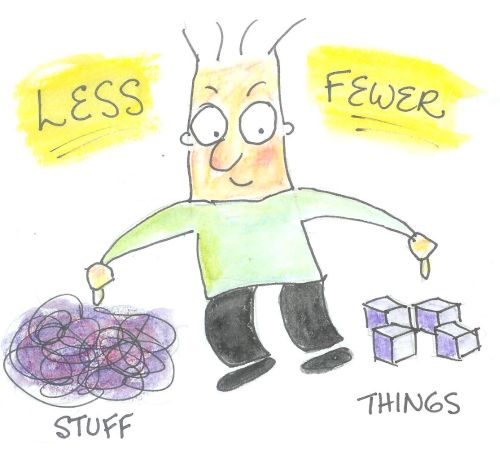
  • 「less」は数えられない名詞、つまり不加算名詞と使います。例えば、money, water, music, airなどですね。
  • 「less」はよく数字と一緒にも使われます。特に、距離や時間についての話題の時です。
  • 「fewer」は、数えられる名詞、つまり可算名詞と使います。例えば、cats, peanuts, flowersなどです。
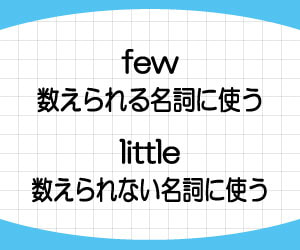
  • “little” ⇒ 数えられない名詞と使う
  • “few” ⇒ 数えられる名詞と使う
​England has _______ farmers than France.
  • イギリスはフランスほど農家が多くない。
Every year, so many Japanese visit Taiwan. _______ visit Nigeria.
  • 毎年大勢の日本人が台湾を訪問する。ナイジェリアに行く人はもっと少ない。
_______ people joined the festival this year than they did last year.
  • 去年より今年の祭りの参加者が少なかった。
Greg ate _______ rice.
  • グレッグはご飯を少ししか食べなかった。
He earns _______ money that he used to.
  • 彼は前ほどお金を稼いでいない。
He has _______ information about the rival company.
  • 彼はライバル会社について少ない情報しか持っていない。
I do way _______ work these days, cuz I'm just tired with my life.
  • 最近前より全然仕事してないよ、だって人生に疲れちゃったんだもん。
I have been in Italy for _______ than two weeks.
  • 私は2週間弱イタリアにいる。
_______ students could answer the question.
  • その質問に答えられる生徒はほとんどいなかった。
I have _______ friends than I used to.
  • 前より友だちが少なくなった。
I want to spend _______ time doing ironing.
  • アイロンの時間を短くしたい。
It has rained these _______ days.
  • ここ数日間、雨が降り続いている。
_______ than 10 people did worked on the job.
  • 10人より少ない人が現場で働いた。
Lisa ate _______ sandwiches.
  • リサはサンドイッチを少ししか食べなかった。
Maggie ate six slices of pizza, and Jess had _______.
  • マギーはピザを6切れ食べたが、ジェスはそれほどは食べなかった。
She has _______ friends here.
  • 彼女はここにほとんど友達がいない。
Showering uses _______ water than taking bathes.
  • 湯船に浸かるよりシャワーの方が使う水が少ない。
The catcher played _______ innings than the shortstop did.
  • キャッチャーの出場イニング数は、ショートよりも少なかった。
The island is _______ than five kilometers away.
  • 島は5キロ未満離れている。
There are far _______ cars on the street than I thought.
  • 通りの車は思ったよりかなり少ない。
There is _______ water here than there.
  • そこよりここの水のほうが少ない。
There is _______ water in the well.
  • その井戸にはほとんど水がない。
There was _______ juice in the plastic bottle.
  • ペットボトルにはジュースが少ししか入ってない。
There were _______ carrots in the fridge.
  • 冷蔵庫には少ししかニンジンがなかった。
There were _______ houses near the river.
  • その川の近くにはほとんど家がなかった。
These days, _______ people are playing sports.
  • 近頃、スポーツをする人が少なくなった。
They had _______ money with them.
  • 彼らは手元にほとんどお金を持っていなかった。
They have _______ formal clothes for a party.
  • 彼らはパーティー用のフォーマルな服を少ししか持っていない。
They have very _______ rain in the desert.
  • その砂漠ではほっとんど雨が降らない。
Very _______ people believed the story.
  • その話を信じる人はまず居なかった。
We had _______ snow last year.
  • 去年はほとんど雪が降らなかった。
You should drink _______ alcohol.
  • アルコールの飲む量減らしなよ。
You should drink _______ beer.
  • ビールを飲む量をもっと減らした方がいいよ。
Picture
​England has fewer farmers than France.
  • イギリスはフランスほど農家が多くない。
Every year, so many Japanese visit Taiwan. Fewer visit Nigeria.
  • 毎年大勢の日本人が台湾を訪問する。ナイジェリアに行く人はもっと少ない。
Fewer people joined the festival this year than they did last year.
  • 去年より今年の祭りの参加者が少なかった。
Greg ate little rice.
  • グレッグはご飯を少ししか食べなかった。
He earns less money that he used to.
  • 彼は前ほどお金を稼いでいない。
He has little information about the rival company.
  • 彼はライバル会社について少ない情報しか持っていない。
I do way less work these days, cuz I'm just tired with my life.
  • 最近前より全然仕事してないよ、だって人生に疲れちゃったんだもん。
I have been in Italy for less than two weeks.
  • 私は2週間弱イタリアにいる。
Few students could answer the question.
  • その質問に答えられる生徒はほとんどいなかった。
I have fewer friends than I used to.
  • 前より友だちが少なくなった。
I want to spend less time doing ironing.
  • アイロンの時間を短くしたい。
It has rained these few days.
  • ここ数日間、雨が降り続いている。
Fewer than 10 people did worked on the job.
  • 10人より少ない人が現場で働いた。
Lisa ate few sandwiches.
  • リサはサンドイッチを少ししか食べなかった。
Maggie ate six slices of pizza, and Jess had fewer.
  • マギーはピザを6切れ食べたが、ジェスはそれほどは食べなかった。
She has few friends here.
  • 彼女はここにほとんど友達がいない。
Showering uses less water than taking bathes.
  • 湯船に浸かるよりシャワーの方が使う水が少ない。
The catcher played fewer innings than the shortstop did.
  • キャッチャーの出場イニング数は、ショートよりも少なかった。
The island is less than five kilometers away.
  • 島は5キロ未満離れている。
There are far fewer cars on the street than I thought.
  • 通りの車は思ったよりかなり少ない。
There is less water here than there.
  • そこよりここの水のほうが少ない。
There is little water in the well.
  • その井戸にはほとんど水がない。
There was little juice in the plastic bottle.
  • ペットボトルにはジュースが少ししか入ってない。
There were few carrots in the fridge.
  • 冷蔵庫には少ししかニンジンがなかった。
There were few houses near the river.
  • その川の近くにはほとんど家がなかった。
These days, fewer people are playing sports.
  • 近頃、スポーツをする人が少なくなった。
They had little money with them.
  • 彼らは手元にほとんどお金を持っていなかった。
They have few formal clothes for a party.
  • 彼らはパーティー用のフォーマルな服を少ししか持っていない。
They have very little rain in the desert.
  • その砂漠ではほっとんど雨が降らない。
Very few people believed the story.
  • その話を信じる人はまず居なかった。
We had little snow last year.
  • 去年はほとんど雪が降らなかった。
You should drink less alcohol.
  • アルコールの飲む量減らしなよ。
You should drink less beer.
  • ビールを飲む量をもっと減らした方がいいよ。
0 Comments

alreadyとyetとstillの使い分け

5/23/2019

0 Comments

 
Picture
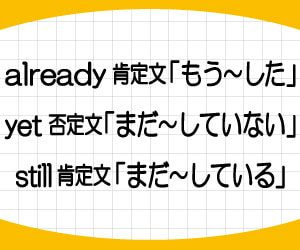
​① already : もう
② yet : もう(疑問文)、まだ(否定文)
③ still : まだ、いまだに、相変わらず
Are you ready _________?
  • もう準備はできましたか。
Are you _________ here?
  • あなたはまだここにいたの?
Do you _________ want to go shopping tomorrow?
  • まだ明日買い物に行きたいですか?
Don't go _________.
  • まだ行くな。
Have you _________ been there?
  • あなたはもうそこにいったことがあるのですか?
Have you eaten breakfast _________?
  • あなたはもう朝ごはんを食べましたか?(「相手はいつか朝ごはんを絶対食べると期待していますが、もう食べたのかどうかを確認している」というニュアンス。)
Have you finished your homework _________?
  • あなたはもう宿題を終わらせましたか?
Have you written the report _________?
  • 報告書をもう書いちゃったの?(早いね)
Have you written the report _________?
  • (現時点で) あなたはもう報告書を書きましたか?
He has _________ found a good job.
  • 彼はもういい仕事を見つけました。
He has _________ gone.
  • 彼はもういない。
He has not found a good job _________.
  • 彼はまだ良い仕事を見つけていません。
He hasn't finished his homework _________.
  • 彼はまだ宿題を終えていません。
He hasn't written the report _________.
  • (現時点で) 書き終えていて当然の報告書をまだ書いてない。
He is _________ snug in bed.
  • 彼はもう夜中だ
He is _________ angry.
  • 彼はまだ怒っています。
He _________ hasn't found a good job.
  • 彼はまだ良い仕事を見つけていない。
I have _________ finished my homework.
  • もう宿題は済ませた。
I have _________ given up on him.
  • もう彼を見切りました。
I have _________ seen her.
  • 私はすでに彼女に会いました。
I haven't read it _________.
  • 私はまだそれを読んでいません。
I haven’t cooked dinner _________. If you’re hungry, have a rice ball.
  • 私はまだ夕食を作っていない。お腹空いているなら、おにぎりを食べてください。
I haven’t finished my dissertation _________.
  • 私はまだ論文を終えていません。(「論文を書いている途中だ」というニュアンス。)
I _________ can’t eat cucumber.
  • 私はまだきゅうりを食べられません。(昔からきゅうりが好きじゃない」というニュアンス。)
I _________ like this band. I started liking this band when I was at junior high school.
  • 私はこのグループをまだ好きです。このグループを初めて好きになったのは中学校の頃でした。
I _________ love him.
  • 彼を愛し続けている。
I _________ love you.
  • 私はまだあなたの事が愛していますよ。
I'm _________ sleepy, so I'm going to sleep.
  • もう眠いから寝ます。
Is it raining _________?
  • 雨はもう降っていますか。
Is she _________ here?
  • 彼女はまだここにいますか。
It is _________ raining.
  • 雨はまだ降り続いています。
It isn’t raining _________ ​.
  • 雨はまだ降っていない。(「雨が降りそうだけど、まだ降っていない」というニュアンス。)
It's _________ dark outside.
  • 外はもう暗い.
It’s October now but it’s _________ as hot as summer.
  • もう10月ですが、まだ夏と同じくらい暑いです。
She hasn’t cleaned her room _________.
  • 彼女はまだ部屋を掃除していない。
She is _________ there.
  • 彼女はすでにそこにいます。
She is _________ very young.
  • 彼女はまだとても若いです。
She _________ has not written the report.
  • 彼女はまだ報告書を書いていない。
She _________ hasn’t called me.
  • 彼女はまだ私に電話してくれていません。
She _________ hasn’t done her homework.
  • 彼女はまだ宿題をやっていない。
That has _________ been decided.
  • それは既に決まっている。
The child speaks _________.
  • 子どもがもうものを言う
The teacher explained this math problem to me many times but I _________ don’t understand.
  • 先生は私に何回もこの数学の問題を説明してくれましたけど、私はまだ理解できません。
The train _________ left.
  • 列車は出たところだ。
Why! It's eleven o'clock _________!
  • おやもう 11 時だ.
Yes, he has _________ written it.
  • はい、もう書きました。
You are in your summer suit _________.
  • もう夏服か
You haven't eaten _________, haven't you?
  • まさか、もう食べてしまったんじゃないでしょうね。
ANSWERS
Are you ready yet?
  • もう準備はできましたか。
Are you still here?
  • あなたはまだここにいたの?
Do you still want to go shopping tomorrow?
  • まだ明日買い物に行きたいですか?
Don't go yet.
  • まだ行くな。
Have you already been there?
  • あなたはもうそこにいったことがあるのですか?
Have you eaten breakfast yet?
  • あなたはもう朝ごはんを食べましたか?(「相手はいつか朝ごはんを絶対食べると期待していますが、もう食べたのかどうかを確認している」というニュアンス。)
Have you finished your homework yet?
  • あなたはもう宿題を終わらせましたか?
Have you written the report already?
  • 報告書をもう書いちゃったの?(早いね)
Have you written the report yet?
  • (現時点で) あなたはもう報告書を書きましたか?
He has already found a good job.
  • 彼はもういい仕事を見つけました。
He has already gone.
  • 彼はもういない。
He has not found a good job yet.
  • 彼はまだ良い仕事を見つけていません。
He hasn't finished his homework yet.
  • 彼はまだ宿題を終えていません。
He hasn't written the report yet.
  • (現時点で) 書き終えていて当然の報告書をまだ書いてない。
He is already snug in bed.
  • 彼はもう夜中だ
He is still angry.
  • 彼はまだ怒っています。
He still hasn't found a good job.
  • 彼はまだ良い仕事を見つけていない。
I have already finished my homework.
  • もう宿題は済ませた。
I have already given up on him.
  • もう彼を見切りました。
I have already seen her.
  • 私はすでに彼女に会いました。
I haven't read it yet.
  • 私はまだそれを読んでいません。
I haven’t cooked dinner yet. If you’re hungry, have a rice ball.
  • 私はまだ夕食を作っていない。お腹空いているなら、おにぎりを食べてください。
I haven’t finished my dissertation yet.
  • 私はまだ論文を終えていません。(「論文を書いている途中だ」というニュアンス。)
I still can’t eat cucumber.
  • 私はまだきゅうりを食べられません。(昔からきゅうりが好きじゃない」というニュアンス。)
I still like this band. I started liking this band when I was at junior high school.
  • 私はこのグループをまだ好きです。このグループを初めて好きになったのは中学校の頃でした。
I still love him.
  • 彼を愛し続けている。
I still love you.
  • 私はまだあなたの事が愛していますよ。
I'm already sleepy, so I'm going to sleep.
  • もう眠いから寝ます。
Is it raining yet?
  • 雨はもう降っていますか。
Is she still here?
  • 彼女はまだここにいますか。
It is still raining.
  • 雨はまだ降り続いています。
It isn’t raining yet.
  • 雨はまだ降っていない。(「雨が降りそうだけど、まだ降っていない」というニュアンス。)
It's already dark outside.
  • 外はもう暗い.
It’s October now but it’s still as hot as summer.
  • もう10月ですが、まだ夏と同じくらい暑いです。
She hasn’t cleaned her room yet.
  • 彼女はまだ部屋を掃除していない。
She is already there.
  • 彼女はすでにそこにいます。
She is still very young.
  • 彼女はまだとても若いです。
She still has not written the report.
  • 彼女はまだ報告書を書いていない。
She still hasn’t called me.
  • 彼女はまだ私に電話してくれていません。
She still hasn’t done her homework.
  • 彼女はまだ宿題をやっていない。
That has already been decided.
  • それは既に決まっている。
The child speaks already.
  • 子どもがもうものを言う
The teacher explained this math problem to me many times but I still don’t understand.
  • (先生は私に何回もこの数学の問題を説明してくれましたけど、私はまだ理解できません。)
The train already left.
  • 列車は出たところだ。
Why! It's eleven o'clock already!
  • おやもう 11 時だ.
Yes, he has already written it.
  • はい、もう書きました。
You are in your summer suit already.
  • もう夏服か
You haven't eaten already, haven't you?
  • まさか、もう食べてしまったんじゃないでしょうね。
0 Comments

embarrassed-ashamed-shy の使い分け

5/21/2019

0 Comments

 
① embarrassed
しくじって決まりの悪い思いをしたり、自分の欠点を意識して、他人に顔向けができない時の気持ちをあらわします。

② ashamed
道徳的・社会的に反していることを行い、自分の良心のとがめを意識したときに使います。
​

③ shy
性格や経験が原因で、気持ちがうわずったり、緊張してどう振る舞って良いかわからない様子や、照れくささを表します。
Picture
A real man would be __________ of doing that.
  • そんなことをするのは男の恥だ.
Are you __________ for having lied?
  • 嘘をついたことを恥じているか
Aren't you __________ of yourself, a grown man in tears!
  • 泣くな. 大の男がみっともない.
Can you believe that I was __________ when I was a kid?
  • 私が子供のころ 恥ずかしがりだったと信じられますか?
Don't be __________ of being poor.
  • 貧乏であることを恥じるな。
He acts very __________ in her presence.
  • 彼は彼女のいる前ではとてもてれくさそうにする。
He changed from a __________ person into quite a politician.
  • 彼は内気な人間からいっぱしの政治家に変身した
He is __________ of being idle.
  • 彼は、怠惰であることを恥じている。
He is __________ of his failure.
  • 彼は失敗を恥じている。
He is __________ for asking such a stupid question.
  • 彼はそんなばかな質問をしたことを恥ずかしがっている。
He is not __________ of begging.
  • 乞食をして恥じぬ
He is __________ but brilliant.
  • 彼は内気だが才能がある。
He loves her very much, but he is too __________ to talk to her.
  • 彼は彼女をとても愛している、でも恥ずかしくて彼女に話しかけることができない。
He was a very __________ boy.
  • 彼はとてもはにかみ屋だった
He was __________ of his ignorance.
  • 彼は自分の無知を恥じていた。
He was __________ at first.
  • 最初は彼は恥ずかしそうにしていた。
 He's __________ with strangers. 
  • 彼は人見知りする.
His words of praise __________ me.
  • 彼のほめ言葉が面映ゆかった
I am __________ to appear in public.
  • 面目無くて人に合わす顔が無い
I am __________ to show my face.
  • 面目なくて合わす顔が無い
I am __________ about failing that test.
  • 私はその試験に落ちたことを恥ずかしく思っている。
I am __________ by debts.
  • 僕は借金で苦しい
I am __________ that I had forgotten about that.
  • それを忘れていて恥ずかしいです。
I am more __________ than I am quiet.
  • 大人しいというよりも人見知りをする。
I am really __________ of myself.
  • 誠に赤面の至りです.
I am __________ and timid.
  • 私は気が小さいです。
I am so __________ I could cry.
  • 私は恥ずかしくて泣きそうです。
I feel __________ of having lost my temper.
  • ついかっとなったことが恥ずかしい。
I feel so __________ for cheating on the test.
  • 私はそのテストでカンニングをしてしまいとても恥ずかしい。
I felt __________ by the excessive praise.
  • おおげさにほめられてくすぐったかった
I get very __________.
  • 私はとても人見知りをします。
I must admit to feeling __________. 
  • われながら恥ずかしいと言わざるをえない.
I was an intensely __________ kid.
  • 私は人見知りが激しい子でした。
I was __________ because he kept staring at me.
  • 彼がじろじろ見るので私はきまりが悪かった.
I was __________ by his bad manners.
  • 彼のマナーの悪さには参ったよ。
I was __________ by what she said.
  • 彼女の言葉を聞いてどぎまぎした。
I was __________ that I didn't know the name of the prime minister.
  • 総理大臣の名前を知らないことを恥ずかしく思った。
I was so __________ that I left the party quickly.
  • 私はとても恥ずかしかったのでそのパーティをすぐに出た。
I'm a __________ person.
  • 私は恥ずかしがり屋です。
I'm __________ because I acted foolishly.
  • ばかなことをしてしまって恥ずかしい。
I'm __________ to look you in the face.
  • 君に合わせる顔がない.
I'm __________ that I can't write in English.
  • 私は英語で文章が書けないことが恥ずかしい。
Jane was really __________ because she spilled her drink on her boss.
  • ジェーンは彼女の上司に彼女の飲み物をこぼして本当に恥ずかしかった。
John is __________ that he cannot sing well.
  • ジョンは歌うのが上手でないことを恥ずかしく思っている。
Many Japanese are __________.
  • 多くの日本人はシャイだ。
My children are __________ of strangers.
  • うちの子供は知らない人に対しては用心深い.
My son is very __________.
  • 私の息子はとても恥ずかしがりやです。
Our son is never __________ in front of strangers.
  • うちの子は知らない人の前に出ても物おじしない.
She appears to be a little __________.
  • 彼女は少しはにかんで見える。
She is more __________ than cold.
  • 彼女は冷たいよりもむしろ内気なのです。
She is __________ and talks little.
  • 彼女は恥ずかしがりで無口だ。
She was __________ of her children's behavior.
  • 彼女は子供の振る舞いを恥じた。
That girl is far from being __________.
  • あの女の子は内気どころではない。
The question __________ me.
  • そう尋ねられてきまりが悪かった
The revelation __________ the administration.
  • その暴露が政府を当惑させた.
The __________ student lingered in the corner.
  • 積極的でない生徒は角で無駄な時間を過ごした
The students in this school are very __________.
  • この学校の生徒はとても恥ずかしがりです。
The therapist drew out the __________ girl.
  • 療法士は内気な女の子を解けさせた
Unlike Hanako, I am innocent and __________.
  • 私は花子とは違って純粋で恥ずかしがり屋です。
You have no need to be __________.
  • 何も恥ずかしがる必要はない.
You ought to be __________ of yourself!
  • みっともないぞ!
You should be __________ of your folly.
  • 君は、自分の愚かさを恥ずべきだ。
You should be __________ of yourself!
  • 恥を知りなさい!
Answers
​
A real man would be ashamed of doing that.
  • そんなことをするのは男の恥だ.
Are you ashamed for having lied?
  • 嘘をついたことを恥じているか
Aren't you ashamed of yourself, a grown man in tears!
  • 泣くな. 大の男がみっともない.
Can you believe that I was shy when I was a kid?
  • 私が子供のころ 恥ずかしがりだったと信じられますか?
Don't be ashamed of being poor.
  • 貧乏であることを恥じるな。
He acts very shy in her presence.
  • 彼は彼女のいる前ではとてもてれくさそうにする。
He changed from a shy person into quite a politician.
  • 彼は内気な人間からいっぱしの政治家に変身した
He is ashamed of being idle.
  • 彼は、怠惰であることを恥じている。
He is ashamed of his failure.
  • 彼は失敗を恥じている。
He is embarrassed for asking such a stupid question.
  • 彼はそんなばかな質問をしたことを恥ずかしがっている。
He is not ashamed of begging.
  • 乞食をして恥じぬ
He is shy but brilliant.
  • 彼は内気だが才能がある。
He loves her very much, but he is too shy to talk to her.
  • 彼は彼女をとても愛している、でも恥ずかしくて彼女に話しかけることができない。
He was a very shy boy.
  • 彼はとてもはにかみ屋だった
He was ashamed of his ignorance.
  • 彼は自分の無知を恥じていた。
He was shy at first.
  • 最初は彼は恥ずかしそうにしていた。
He's shy with strangers.
  • 彼は人見知りする.
His words of praise embarrassed me.
  • 彼のほめ言葉が面映ゆかった
I am ashamed to appear in public.
  • 面目無くて人に合わす顔が無い
I am ashamed to show my face.
  • 面目なくて合わす顔が無い
I am embarrassed about failing that test.
  • 私はその試験に落ちたことを恥ずかしく思っている。
I am embarrassed by debts.
  • 僕は借金で苦しい
I am embarrassed that I had forgotten about that.
  • それを忘れていて恥ずかしいです。
I am more shy than I am quiet.
  • 大人しいというよりも人見知りをする。
I am really ashamed of myself.
  • 誠に赤面の至りです.
I am shy and timid.
  • 私は気が小さいです。
I am so embarrassed I could cry.
  • 私は恥ずかしくて泣きそうです。
I feel ashamed of having lost my temper.
  • ついかっとなったことが恥ずかしい。
I feel so ashamed for cheating on the test.
  • 私はそのテストでカンニングをしてしまいとても恥ずかしい。
I felt embarrassed by the excessive praise.
  • おおげさにほめられてくすぐったかった
I get very shy.
  • 私はとても人見知りをします。
I must admit to feeling ashamed.
  • われながら恥ずかしいと言わざるをえない.
I was an intensely shy kid.
  • 私は人見知りが激しい子でした。
I was embarrassed because he kept staring at me.
  • 彼がじろじろ見るので私はきまりが悪かった.
I was embarrassed by his bad manners.
  • 彼のマナーの悪さには参ったよ。
I was embarrassed by what she said.
  • 彼女の言葉を聞いてどぎまぎした。
I was embarrassed that I didn't know the name of the prime minister.
  • 総理大臣の名前を知らないことを恥ずかしく思った。
I was so embarrassed that I left the party quickly.
  • 私はとても恥ずかしかったのでそのパーティをすぐに出た。
I'm a shy person.
  • 私は恥ずかしがり屋です。
I'm ashamed because I acted foolishly.
  • ばかなことをしてしまって恥ずかしい。
I'm ashamed to look you in the face.
  • 君に合わせる顔がない.
I'm embarrassed that I can't write in English.
  • 私は英語で文章が書けないことが恥ずかしい。
Jane was really embarrassed because she spilled her drink on her boss.
  • ジェーンは彼女の上司に彼女の飲み物をこぼして本当に恥ずかしかった。
John is embarrassed that he cannot sing well.
  • ジョンは歌うのが上手でないことを恥ずかしく思っている。
Many Japanese are shy.
  • 多くの日本人はシャイだ。
My children are shy of strangers.
  • うちの子供は知らない人に対しては用心深い.
My son is very shy.
  • 私の息子はとても恥ずかしがりやです。
Our son is never shy in front of strangers.
  • うちの子は知らない人の前に出ても物おじしない.
She appears to be a little shy.
  • 彼女は少しはにかんで見える。
She is more shy than cold.
  • 彼女は冷たいよりもむしろ内気なのです。
She is shy and talks little.
  • 彼女は恥ずかしがりで無口だ。
She was ashamed of her children's behavior.
  • 彼女は子供の振る舞いを恥じた。
That girl is far from being shy.
  • あの女の子は内気どころではない。
The question embarrassed me.
  • そう尋ねられてきまりが悪かった
The revelation embarrassed the administration.
  • その暴露が政府を当惑させた.
The shy student lingered in the corner.
  • 積極的でない生徒は角で無駄な時間を過ごした
The students in this school are very shy.
  • この学校の生徒はとても恥ずかしがりです。
The therapist drew out the shy girl.
  • 療法士は内気な女の子を解けさせた
Unlike Hanako, I am innocent and shy.
  • 私は花子とは違って純粋で恥ずかしがり屋です。
You have no need to be ashamed.
  • 何も恥ずかしがる必要はない.
You ought to be ashamed of yourself!
  • みっともないぞ!
You should be ashamed of your folly.
  • 君は、自分の愚かさを恥ずべきだ。
You should be ashamed of yourself!
  • 恥を知りなさい!
0 Comments

    Archives

    August 2019
    July 2019
    May 2019

    RSS Feed

  • Welcome
  • Homework
  • Contents
  • Study Links
  • Student Page
  • Volunteering
  • Vocabulary